The Geomentry of Beauty
How Natural Law, Energy, and Mastery Meet in the Human Mirror
The Geometry of Beauty
How Natural Law, Energy, and Mastery Meet in the Human Mirror
By Cherie Bianco
The Moment That Changed Everything
It was 1974. Her name was Mary.
She came to me soft-spoken and slight — a research scientist studying diabetes at the University of Chicago Hospital. A woman who spent her days in precision, in data, in solving complex problems that most people couldn't begin to understand. And she sat down in my chair with very fine hair falling all the way down her back, and told me she wanted something new.
I explained what I saw. Very fine hair, I told her, has no medulla — no inner core. It is, essentially, a forest of baby-thin trees, and like any forest of delicate things, when it grows long enough, gravity wins. The weight pulls it flat, strips it of life, and flattens the very features it was meant to frame. Her small face, her delicate bone structure, the eyes she probably didn't realize were remarkable — all of it was being swallowed.
We talked. We agreed. And I began to cut.
I was coming around to the side of her head, nearly finished, when I noticed it. Tears. Running quietly down her cheeks.
I stopped immediately. It frightened me. Is she okay? Did I do something wrong?
I asked her softly. She looked at me in the mirror and said, just as softly: "Yes. I'm fine. I just didn't realize how attached I was to all that hair."
Mary became my longest, most loyal client from 1974 until I left Chicago in 2010.
And in that single moment — her tears, her stillness, that quiet reckoning in the mirror — I understood something I would spend the next five decades trying to articulate.
This was never about hair.
What They're Really Asking
Over fifty-eight years, I have stood across from human beings looking into a mirror. I estimate I have sat with more than 73,000 people in private, one-to-one consultations. Each person arrived with a story about themselves — almost always spoken through their hair.
"My hair is too thin." "My hair has no life." "Nothing looks good on me." "I don't know what to do anymore."
But beneath those words — every single time — lived a deeper, quieter question.
Who am I now?
Psychologists have a name for what happens when a person's outer appearance doesn't match their inner sense of self: identity incongruence. It creates a low-grade friction that most people can't quite name. They just know something feels off. They look in the mirror and don't fully recognize the person looking back.
What neuroscience has since confirmed is something I observed intuitively across decades: being truly seen by another person — having someone look at you with full attention and genuine care — activates the brain's mirror neuron system. We are wired, at a biological level, to feel more real, more coherent, more ourselves, when someone else witnesses us clearly.
The consultation chair, I came to understand, was doing something neurological before I ever touched a pair of scissors.
It was offering the experience of being heard.
And for some people — perhaps more than we would like to admit — that experience was not common in their lives.
Nature Knew First
Early in my career I began noticing something I couldn't immediately explain. Certain proportions always seemed to work. Certain balances always created harmony. Some adjustments made a person suddenly appear radiant — not because I had done something dramatic, but because I had simply stopped fighting what was already there.
At first I thought it was intuition. And it was. But over time I realized my intuition was tracking something real — a mathematical pattern woven into the structure of the natural world.
It is called the Golden Ratio.
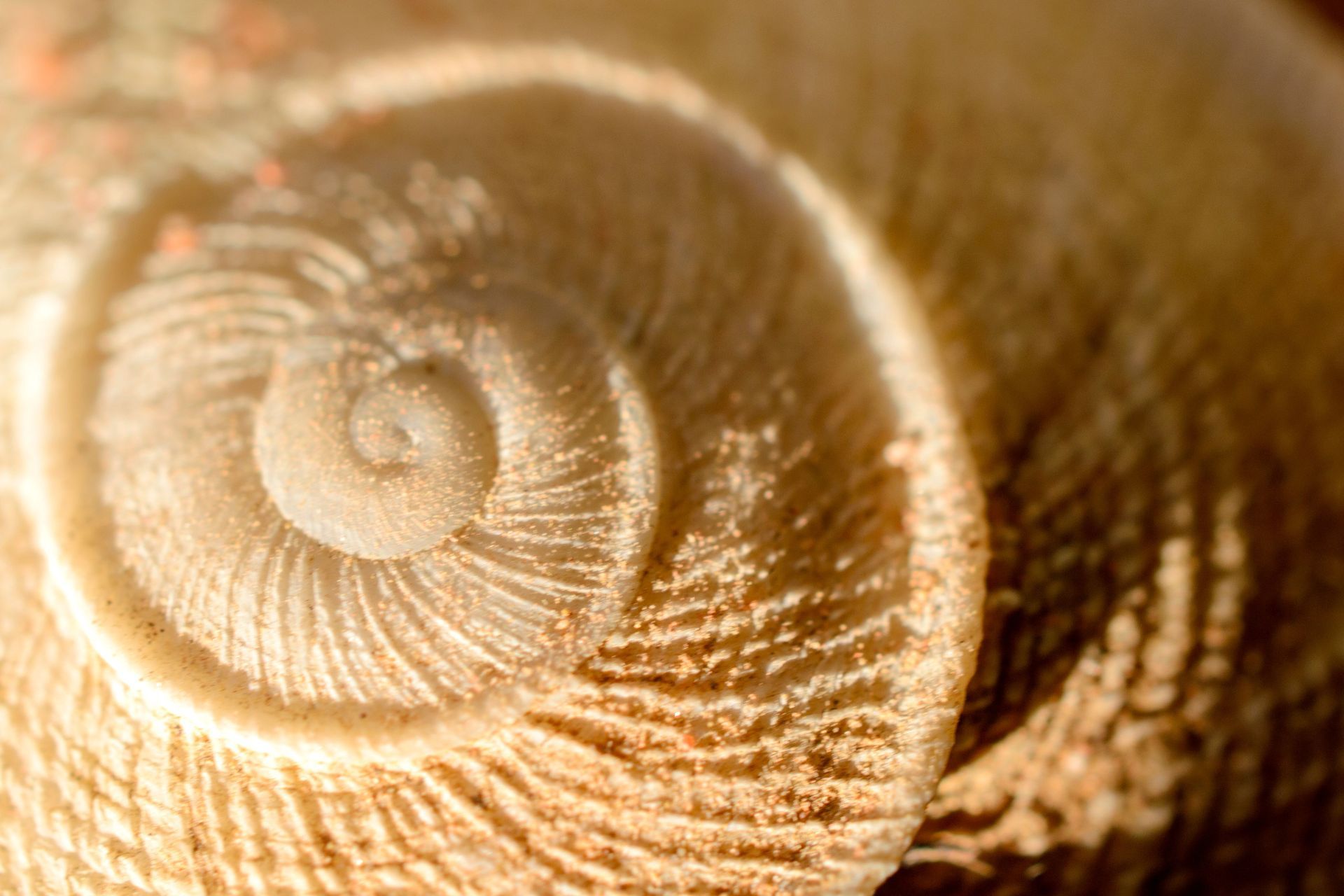
Expressed mathematically as 1.618, the Golden Ratio describes a proportion so elegant that the human eye perceives it as inherently balanced and pleasing — without knowing why. It appears in the spiral of a nautilus shell, the unfurling of a fern, the seed pattern of a sunflower, the arms of a galaxy. Nature returns to this ratio again and again, across every scale of existence, as if it is the universe's preferred grammar for building beautiful things.
And it appears in the human face.
The distance between the eyes relates proportionally to the width of the face. The placement of the nose aligns with natural facial thirds. The arc of the jaw follows curves the eye recognizes as harmonious. Hairlines and crown growth patterns often spiral in forms that echo the Fibonacci sequence — the mathematical series (1, 1, 2, 3, 5, 8, 13, 21...) from which the Golden Ratio naturally emerges.
What this means in practice — in the chair, with scissors in hand — is that hair is not decoration placed on the face. It is a frame that either honors or disrupts the geometry already present. My work was always to honor it.
But here is what the geometry alone cannot tell you.
The Science of the Strand
No two human beings have the same hair. And understanding why — at the structural level — is what separates a great consultation from a guess.
Every hair strand has a shape. That shape determines everything.
Fine hair — what I call baby hair — is perfectly round in cross-section, and small. No medulla, no inner core. Imagine a forest of the thinnest possible trees: individually delicate, collectively creating an illusion of volume that gravity slowly dismantles. Fine hair is best understood on its own terms. It is not weak. It is simply limited by physics. Work with that limit, and it becomes luminous. Fight it, and the person spends every morning in frustration.
Coarse hair is also round in cross-section, but larger — a stronger, more substantial strand that holds its own shape and resists easy manipulation. It has presence and power. It is not particularly pliable, and it doesn't need to be. Its strength is its nature.
Wavy and curly hair is where the geometry becomes visible to the naked eye. These strands are oval in cross-section — and as they grow out from the follicle, the oval shape causes the strand to spin. The more pronounced the oval, the tighter the spin. A mild oval produces a wave. A more severe oval produces a spiral. A very pronounced oval produces a corkscrew curl. The curl is not a defect or a complication. It is physics, made visible. It is geometry, growing out of the scalp.
Understanding this — truly understanding it, in the hands and the eye — means the consultation changes entirely. Because now you are not trying to impose a style onto hair. You are collaborating with what the hair is already doing, working within its honest range, and finding the most beautiful expression of its natural law.
The Three Variables
Every consultation I have ever done was, at its core, a real-time negotiation of three variables.
First: the face. Every face has its own geometry — its own unique combination of proportions, bone structure, and spatial relationships. No two are identical. The work is to read those proportions without judgment and ask: what does this face need in order to feel like itself? Where is the balance point? What framing would let these eyes come forward, let this bone structure breathe, let this person's particular beauty become legible?
Second: the hair. What is its honest nature? What can it do, and what will it always resist? Fine hair has limits. Coarse hair has limits. Every curl pattern has limits. Mastery means knowing those limits not as obstacles but as the actual material you're working with — the way a sculptor knows stone. The goal is never to make the hair do something it isn't. The goal is to find the most beautiful version of what it already is.
Third — and this is the one that changes everything — the person's willingness.
I always began the same way. Before anything else, I would ask: How much are you willing to let go of?
Not just in inches. In identity.
Because hair, for most people, is not simply hair. It carries history. It carries the version of themselves they have held onto, sometimes for decades. Length especially — there is almost always a story attached to length. A relationship. A time in life. A self-image that hasn't yet caught up with who they are becoming.
The most important skill I developed over fifty-eight years was not technical. It was learning to read the answer to that question — not just in what someone said, but in how they held their body when they said it. The willingness factor, as I came to think of it, determined everything. Because the most geometrically perfect haircut in the world will not satisfy someone who wasn't ready for it.
I said that out loud, many times, to many people. Because people would sit down and say — often with the best intentions, trying to be easy, trying to be generous — "Just do whatever you want. You're the expert. I trust you."
And I would say: No. I won't do that.
Not because I didn't have ideas. I always had ideas. After decades of reading faces and hair and energy, I could see possibilities the moment someone walked through the door. But giving someone what I think would look amazing — without knowing what they are ready to receive — is not mastery. It is imposition. I could give you something I find extraordinary, and if you aren't ready for that look, that refinement, that version of yourself, you would hate it. And you would hate me for giving it to you.
I much prefer to collaborate.
That word — collaborate — is the one I kept returning to across fifty-eight years. Because what happens in the chair is not a service transaction. It is a co-creation. The person brings their face, their hair, their history, and their readiness. I bring my eye, my skill, and my attention. And together we find something neither of us could have found alone.
That is the work. That has always been the work.
The Consultation as Sacred Science
The most important part of every session happened before I picked up a single tool.
The consultation.
In those first minutes — sitting across from someone, asking questions, listening — I was reading multiple layers simultaneously. I was hearing their words while watching their posture. I was observing hair texture and density while tracking what their eyes did when they talked about what they wanted. I was mapping facial proportions while staying attuned to something harder to name: their energetic presence. How they were inhabiting their own body. Where they seemed at home in themselves, and where they seemed to be hiding.
This is not mysticism. It is attunement — a capacity that develops through decades of paying close attention. Research on expert intuition, including the work of psychologist Gary Klein, shows that true mastery produces a form of pattern recognition that operates faster than conscious thought. The expert doesn't know how they know. They just know. And they are right.
After 73,000 consultations, I was right in a way I couldn't always articulate but could always feel.
The consultation created a bubble. My assistants understood this without being told: unless something was truly urgent, you did not interrupt that space. Because what was happening inside it was not small talk. It was a person, often for the first time in a long time, feeling genuinely listened to. Feeling that someone was paying close enough attention to actually see them — not the role they played, not the way they wished they looked, but them, exactly as they were, with every possibility that entailed.
Self-perception theory, developed by psychologist Daryl Bem, tells us that people form beliefs about themselves partly by observing their own behavior and appearance — the same way they might observe someone else. When that self-observation shifts — when the mirror shows something that feels more true — the belief system begins to shift with it. Not overnight. But the seed is planted in that moment of pause.
I saw it happen 73,000 times.
The pause was almost never spoken aloud. It lived in the body. A softening of the shoulders. A slight forward lean toward the mirror. Eyes that went quiet. Sometimes tears — like Mary's — that arrived before the person even understood why.
That pause was the whole point.
Energy Is Not a Metaphor
There is one more layer I cannot leave out, even though it is the hardest to put into words.
Every wisdom tradition that has studied the human body in depth has arrived at the same conclusion through different language. The yogic tradition calls it Prana. Chinese medicine calls it Chi. Taoist philosophy calls it Qi. The Kundalini tradition describes it as a living current of intelligence that moves through the entire system — nervous system, breath, emotion, posture, and presence.
These are not competing ideas. They are the same observation, made by different cultures across different centuries, about the same phenomenon: that the human body is not just a physical structure. It is a living, flowing system of energy. And the state of that system is visible — if you know how to look.
I learned to look.
Hair, I came to understand, is not separate from this system. It is part of it. Hair responds to stress, to vitality, to hormonal shifts, to the state of the nervous system. A person in chronic fight-or-flight — in survival mode, cut off from their own aliveness — often has hair that reflects exactly that. Dull. Flat. Without movement. Not because of product or damage, but because the life force animating the whole system has gone quiet.
And when that system begins to flow again? The hair changes. Anyone who has gone through a profound personal transformation — a grief survived, a relationship released, a long-held fear finally faced — often notices it first in the body. In the skin. In the hair. There is a luminosity that returns.
This is why I never believed I was just doing hair.
I was reading a person's life force. And doing my best to work in harmony with it.
Mastery Through Repetition
People sometimes ask how mastery forms.
The answer is deceptively simple: repetition with awareness.
Every consultation taught me something. Every haircut revealed a pattern. Every human being who sat across from me refined my capacity to see, to listen, to read what was present and what was possible. Over fifty-eight years, those moments accumulated. 73,000 consultations become 73,000 lessons in observation. Patterns that once required effort to see become effortless to recognize. Balance becomes not a calculation but a felt sense. Energy becomes not a concept but something palpable in the room.
This is how mastery forms. Not through shortcuts. Not through talent alone. Through decades of showing up, paying attention, and staying curious about the person in front of you.
Beauty Is Alignment
I want to be clear about something, because it matters.
True beauty is not perfection.
Perfection is a fixed target that no living thing can hit — because living things are always changing, always moving, always becoming something slightly different than they were yesterday. Chasing perfection is a way of being permanently at war with yourself.
Alignment is different.
Alignment is what happens when the inner life and the outer appearance meet honestly. When geometry, energy, and authenticity come together — even briefly — in the mirror. When the person looking back is recognizable. When someone sees themselves and thinks, yes. That's me.
That moment cannot be manufactured. No technique produces it. No product creates it. It can only be revealed — by removing what's in the way, by honoring what's already there, by listening closely enough to know the difference.
In fifty-eight years, across more than 73,000 private moments in the sacred space of the chair, that is what I was always doing.
Helping people find their way back to themselves.
The Work Continues
Today I bring this lifetime of mastery into a new kind of space.
At Kundalini Bianco — Center for Nervous System and Soul Integration in Borrego Springs, California — the work now includes somatic awareness, breath, energetic alignment, and the reconnection of inner and outer self. The tools are different. The setting is different. The traditions I draw from span Kundalini yoga, Core Energetics, and Q'ero shamanic practice.
But the essence has not changed.
It is still about the same thing it has always been about.
Helping someone look in the mirror — whatever that mirror is — and recognize themselves. Clearer. More aligned. More alive. More true.
Because when that alignment happens, something unmistakable occurs.
A person begins to radiate.
And that radiance was always there, waiting to be seen.
Cherie Bianco is the founder of Kundalini Bianco and creator of the Root to Rise system. She has over fifty years of combined professional experience as a master hair colorist and somatic healing practitioner. She works privately with clients at her studio in Borrego Springs, California.
Recent Posts